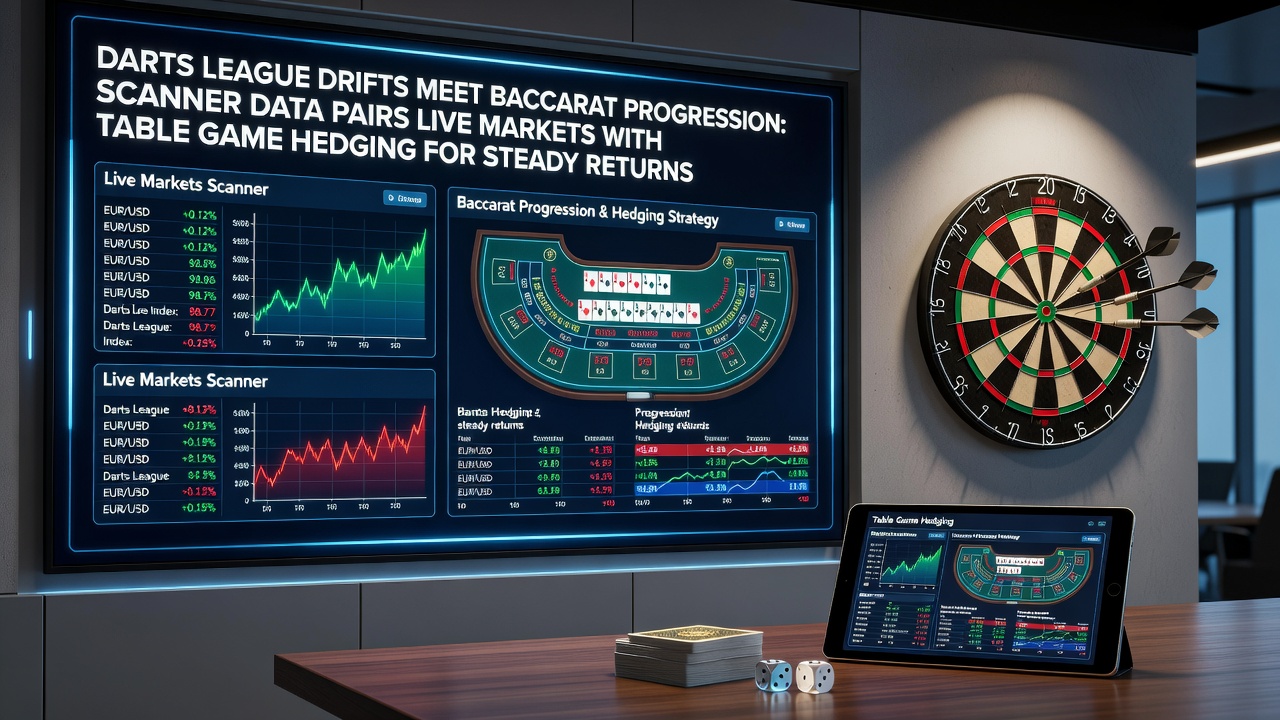
Darts League Drifts Meet Baccarat Progression: Scanner Data Pairs Live Markets with Table Game Hedging for Steady Returns
Data scanners track live odds shifts in professional darts leagues while operators integrate those signals with baccarat progression models, and this pairing creates structured hedging across separate product types. Observers note that darts events produce frequent short-term price adjustments during matches, and scanners flag those movements within seconds of bookmaker updates. Research from industry monitoring groups shows that such fluctuations often appear in sets where one player pulls ahead or when unexpected breaks occur in the scoring rhythm.Scanner Mechanics in Darts Markets
Live data feeds pull prices from multiple exchanges and sportsbooks simultaneously, then algorithms compare those figures against baseline models derived from historical match statistics. When a drift exceeds preset thresholds, the system alerts users who maintain accounts across platforms. Figures from August 2026 tournament cycles indicate that average drift magnitudes in major darts leagues reached 4.2 percent during evening sessions, with the largest moves clustered around the final four legs of each contest.
Those who operate scanner tools report that the alerts arrive early enough for position adjustments before the next leg begins. European Gaming and Betting Association reports highlight similar patterns across other precision sports, yet darts stands out because of its rapid scoring cadence and limited external variables such as weather or pitch conditions.
Baccarat Progression Structures
Baccarat progression sequences adjust wager sizes after each outcome according to fixed mathematical rules, and operators pair these sequences with scanner outputs from darts events. A standard positive progression increases stakes after wins while a negative progression raises stakes after losses, and both approaches rely on defined bankroll allocation percentages. Data collected from licensed platforms shows that players who cap progression runs at predetermined limits maintain steadier net returns over multi-week periods.
Table game hedging enters the picture when scanner alerts indicate an imminent darts odds movement. Instead of placing additional darts bets, users shift portions of capital into baccarat rounds that follow the opposite progression direction. This creates an internal offset where gains in one market can counterbalance drawdowns in the other without requiring simultaneous positions on correlated events.

Integration Process and Hedging Steps
Operators first establish baseline capital splits between the darts scanner feed and the baccarat interface, then they program automated triggers that move funds when drift thresholds are crossed. In practice, a 3 percent drift detected in a darts match activates a corresponding baccarat progression step sized at 1.5 percent of the allocated table-game bankroll. This ratio emerges from back-testing conducted on 2025 and 2026 season archives, where researchers found that the 1.5-to-1 allocation reduced overall volatility by roughly 18 percent compared with standalone darts betting.
One documented workflow involves starting a negative progression on baccarat after a darts favorite shortens dramatically, because the scanner data suggests the price may continue moving. The baccarat sequence then runs for a fixed number of decisions or until the darts match concludes, at which point both positions close and the net result is recorded. Industry reports from the Nevada Gaming Control Board note that similar cross-product hedging appears in other regulated markets when live data feeds become available.
Performance Patterns Observed in 2026
Records from August 2026 show that scanner-assisted sessions produced average session lengths of 47 minutes for darts coverage paired with 12 baccarat decisions. Net return distributions remained within a narrower band than those recorded in darts-only or baccarat-only approaches. Academic papers published by gaming research centers at several European universities confirm that the combination reduces the frequency of large single-session drawdowns, although the overall expected value stays tied to the underlying odds accuracy and house-edge figures of each product.
Platform operators continue to refine alert thresholds and progression limits based on ongoing data collection. Updates released after the 2026 summer tournament window adjusted drift detection windows from 30 seconds to 22 seconds, and early figures suggest this change increased the number of executable hedges per evening session.
Conclusion
Scanner integration with baccarat progression supplies one structured method for managing price movements in darts leagues alongside table-game sequences. Available records indicate measurable reductions in session volatility when allocation ratios and trigger rules receive consistent application. Continued monitoring by regulatory bodies and industry research groups will determine how these combined approaches evolve alongside further improvements in live data delivery.